Amit Sakal

VP Creative
Amit Sakal Recent Posts
The Jewish Lion: How to Build a Brand That Lasts 3,000 Years
By
Amit Sakal
, 04/03/2026
Beyond ancient symbols: How do you build a brand that lasts for millennia? Discover the fascinating branding strategy behind the Jewish Lion – from the Bible to the modern battlefield.
min read
How do you build a brand that lasts for millennia? If you are wondering how to build a brand that lasts for generations, the answer lies in one ancient symbol.Lately, certain names have resurfaced: “Am KeLavi” - A People Like a Lion. “Roaring Lion.”
Operation names. Security language. Headlines. But from a branding perspective, this is a fascinating choice. In an era when nations invest billions in narrative, public diplomacy, and perception management, Israel repeatedly returns to the same ancient symbol: the lion. Not a refreshed logo. Not an updated digital aesthetic. Not a passing graphic trend. A lion. And when you examine it closely, it may be one of the most consistent branding moves in human history.
A Brand That Hasn’t Rebranded Since Genesis
The story begins long before content strategy or visual systems. In the Book of Genesis, Jacob blesses Judah with the words: “Gur Aryeh Yehuda” - Judah is a lion’s cub. This wasn’t merely poetic imagery. It was a foundational positioning decision. The lion wasn’t chosen because it is the strongest animal in the wild. It was chosen because it is perceived as sovereign - a natural authority, a presence that does not need to strive for dominance. In branding terms, this is precise positioning. The lion does not symbolize reckless aggression. It represents restrained power. Not “we attack.” But “we are here - and we are not going anywhere.” That is a far deeper message than brute force.
Design in Exile: When There Is No State, There Is Still a Visual Language
For nearly two thousand years, there was no sovereignty. But there was branding. The lion appeared in synagogues, on Torah arks, in manuscripts - often flanking the Tablets of the Covenant, sometimes crowned. From a design perspective, this was brilliant: When political power disappears, you reinforce the symbol. During exile, the lion was not a call to rebellion. It was an anchor of identity. A form of brand consistency in the midst of historical chaos. Real brands are not built in comfortable eras. They are tested in difficult ones.
Zionism: Rebranding Without Losing the DNA
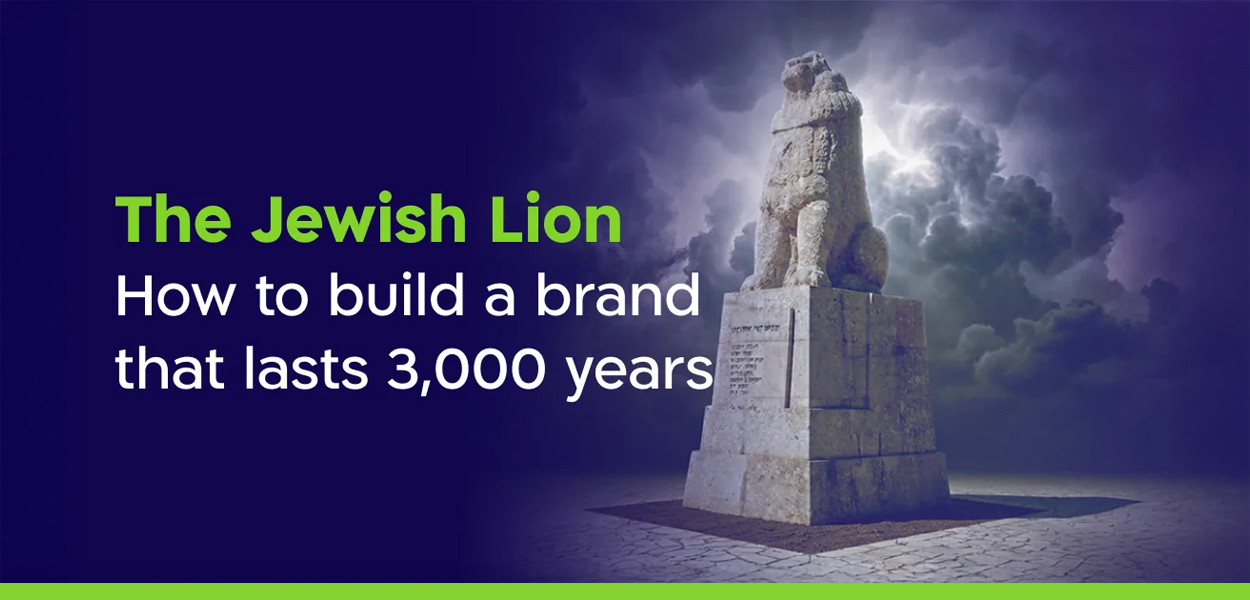
When modern Zionism emerged, it did not invent a new emblem. There was no dramatic visual overhaul. The lion simply shifted tone. Less mystical - more national. Less decorative - more upright. Less memory - more action. This was not a rebrand. It was a tonal update. One of the most powerful visual moments in Israeli cultural history is the “Roaring Lion” monument at Tel Hai. Not a victorious lion. Not a charging lion. A wounded lion - roaring. That is a courageous branding decision. It does not sell “absolute power.” It sells endurance. Resolve. Cost. A brand built on courage through standing firm lasts longer than one built on dominance alone.
The IDF: A Language of Consciousness, Not Just Operations
When military operations are named “Am KeLavi” or “Roaring Lion,” this is not biblical romanticism. It is narrative strategy. Operation names are never merely technical labels. They are messages. Inward - to soldiers and society. Outward - to adversaries and to the world. The lion enables Israel to position itself as restrained yet determined. Not a wild force. Not an imperial aggressor. But an actor capable of patience - and action. The distinction is subtle. And critical.
Why It Still Works
Because the lion carries rare historical depth. It bridges scripture and sovereignty. An ancient verse and a modern fighter jet. Memory and statehood. In a world where brands redesign their logos every five years, the Jewish lion is proof that true brand equity is built across generations. Not through trends. Through consistency.
What Can Branding Professionals Learn From This?
- A strong symbol doesn’t need to shout constantly.
- Deep brands are anchored in story, not aesthetics alone.
- Long-term consistency outperforms cosmetic refreshes.
- Restrained power is a strategy - not a weakness.

B2B Design & Tech Trends 2026: From Visual Appeal to Strategic Experience
By
Amit Sakal
, 12/01/2026
In 2026, B2B design is more than just a modern look—it’s a strategic engine for clarity. Discover the six key shifts, from Hybrid Intelligence to Vibe Code, that help users understand complex products and drive faster decisions.
min read
Design and tech trends in 2026 reveal that B2B design isn’t just about looking modern.
It’s about clarity. It’s about helping users understand complex products faster, feel more confident, and make decisions with less friction. As buying journeys become more self-directed, design is evolving into a strategic layer that connects technology, experience, and business outcomes.
Here are the six shifts defining this evolution.


Multi-Sensory Experiences & Hybrid Intelligence When design is felt, not just seen
2026 marks a clear shift from purely visual design to multi-sensory digital experiences. After years of screen fatigue, users crave interfaces that feel richer, more immersive, and more human. Even in digital environments, design now aims to evoke sensations associated with touch, depth, motion, and materiality. This is where Hybrid Intelligence: the collaboration between AI and human creativity becomes a powerful driver. AI is deeply embedded into the creative workflow:- Generating visual directions and variations
- Exploring textures, motion, and spatial depth
- Accelerating experimentation and ideation
- Soft, tactile, and inflated textures
- Hyper-realistic objects combined with playful distortions
- Subtle motion that suggests weight, resistance, and flow
- Interfaces that feel immersive rather than flat

Glassmorphism, Evolved Transparency as a system, not a decoration
Glassmorphism continues into 2026 - but in a more mature and intentional form. What once appeared as a visual trend is now becoming a functional design system used to manage hierarchy, density, and focus. In B2B interfaces especially, where dashboards, data layers, and dense content are common, glass-like surfaces help:- Separate layers without heavy borders
- Maintain context while guiding attention
- Create depth without visual noise

Vibe Code & Self-Serve UX Design that explains before sales ever enter the room
Modern B2B buyers don’t want to be sold to first - they want to understand. In 2026, the most effective B2B experiences are built around self-serve exploration:- Interactive demos
- Calculators and simulators
- Product explorers and configurators
- Guided journeys that adapt to user intent
- Answering questions before they are asked
- Allowing users to test scenarios on their own
- Building confidence before human interaction

White, Minimalism & Visual Calm Less noise, more authority
White and near-white palettes dominate B2B design in 2026, not as an aesthetic trend, but as a strategic choice. Minimalist layouts, generous spacing, and visual restraint are essential when:- Products are complex
- Messages need credibility
- Decisions carry high business impact

Dynamic Personalization at Scale One interface, many audiences
B2B audiences are rarely uniform. Different roles, industries, regions, and levels of expertise require different messaging and in 2026, design finally reflects that reality. Interfaces are becoming more adaptive:- Content shifts based on industry or role
- Messaging adjusts to user behavior or entry point
- Visual emphasis changes according to intent

Design as a System, Not a Page Modular, scalable, and built for growth
In 2026, strong B2B design is rarely page-based. It’s system-based. Design systems evolve to support:- Rapid scaling across products and markets
- Consistency across platforms and touchpoints
- Faster iteration without breaking brand integrity
Closing Thought
Design in 2026 is not about trends for the sake of trends. It’s about using design to reduce complexity, build trust, and create meaningful experiences in an increasingly technical world. For B2B brands, the opportunity is clear: Those who treat design as a strategic layer - not a visual afterthought — will lead the conversation, not follow it.
Design as an Anchor in a World of Constant Disruption
By
Amit Sakal
, 19/11/2025
When the market shifts fast, design becomes your anchor—creating clarity, stability, and trust at every touchpoint.
min read
The world around us doesn’t slow down. Markets shift overnight.
New competitors appear out of nowhere.
Technologies, especially AI - rewrite the rules faster than we can learn them.
For most companies, this constant change is both thrilling and exhausting.
One moment you’re ahead, the next you’re trying to catch up.
But in all this chaos, there’s one thing that can help your brand feel steady - design.
Not “design” as in nice colors or a modern website layout, but design as a language of trust.
Because when everything around your audience feels unstable, design is the thing that quietly says: We’re still here. We’re solid. You can rely on us.

Why design matters now more than ever
In the B2B world, design has often been treated as an afterthought, something that comes after strategy, product, or pricing. But that view is outdated. Design today does something deeper. It shapes how people feel about your brand, before they even read a word or see a product demo. When the world outside feels unpredictable, a clear and consistent design system becomes your anchor. It tells your customers: “We know who we are, and we’re not going anywhere.” Consistency across your website, social channels, trade shows, and sales decks helps people navigate complexity without getting lost. It’s like a compass - helping them find their way back to you, no matter how much the landscape shifts
Stability and innovation aren’t opposites
Here’s the misconception: that consistency limits creativity. In reality, good design gives innovation a safe place to land. Take IBM. They’ve reinvented themselves countless times - from hardware to cloud to AI, but their design DNA has stayed recognizable: bold typography, clean grids, and that unmistakable IBM blue. The message? Technology evolves, but our foundation is steady. Or Siemens. They operate in industries that are changing by the minute - energy, healthcare, infrastructure, yet their design system ties everything together. It’s what makes them feel like one brand, no matter where you meet them in the world. And Adobe, a masterclass in transformation. They moved from selling software boxes to building creative ecosystems in the cloud. Now they’re redefining creativity with AI tools - but the red square, the simple geometry, and the minimal style haven’t changed. That visual continuity made it easy for their customers to follow them through every pivot. These brands prove a simple truth: Consistency in design doesn’t stop innovation. It makes innovation trustworthy.
What B2B brands should take from this
Many industrial or tech companies still believe design is “just aesthetics.” They assume customers only care about ROI, performance, or reliability. But customers are human. And humans notice design - even subconsciously. A strong design system sends emotional signals of stability and confidence. It helps people trust your innovation, not fear it. So if you want to build long-term relationships, treat your design system as your North Star:- Keep it consistent across every touchpoint.
- Use it to simplify complexity, not add to it.
- Let it evolve, but never drift away from your brand’s essence.