December 29, 2025

What if I told you that the internal tools you use today don’t have to come from a plugin, an off-the-shelf system, or a solution that doesn’t quite fit?
And what if the most precise tools for your workflow are the ones that don’t even exist yet—until you build them?

In recent years, something profound has been happening quietly. Internal tools—those that once required developers, endless work hours, and a significant budget—have suddenly become accessible to everyone. AI is not just changing the way we work; it’s changing who can build the tools we work with.

Systems that used to be massive projects can now be built within hours. The person writing the brief can become the one creating the solution. Internal tools no longer have to be bought off-the-shelf or from an external vendor. They can be born out of a daily process, a recognized need, and a deep understanding of how we actually work.

This is exactly what happened with us. Time and again, we discovered that a certain process was stalling us, that communication was dragging, or that a small action was turning into a major task. So, instead of searching for a plugin that “sort of” fits, we built tools that were precise for us: a task-sharing system for clients, an email signature generator based on an existing design, custom forms, and finally, a QA tool that grew from a small idea into a system that works on any website.


When the Process Needs a Tool, Not Another Meeting

In most projects, the problem isn’t the people or the understanding. The problem is the tools—or more accurately, the lack thereof.
We learned long ago that the solution to ambiguity isn’t another meeting or another document. Sometimes, all you need is a small tool that organizes reality right where the process gets stuck.

That’s how we started building our own internal tools with AI.
No heavy systems, no generic plugins; just solutions born from our real needs and those of our clients. Just as we build websites for our clients, we began designing our own internal work processes.

During the past year, we created several internal tools using AI, including:

  • A task sharing and tracking system between clients and the team.

  • An email signature generator that creates a customized version for every user.

  • Interactive forms for various clients as needed.

  • A visual QA system that operates directly on the website.

  • A smart system for creating digital business cards.

Every one of these tools was born from the same point: a small pain point that grew. AI made the development of these solutions simple, fast, and accessible.

This is perhaps the greatest AI revolution. It allows businesses like ours to build internal tools that were previously reserved for corporate giants. Today, you can create a precise solution the moment it’s required, instead of adapting to what already exists.

How a Small Idea Became a Plugin That Works on Any Site

It all started with a pain point familiar to every digital team: scattered comments, long review cycles, endless question marks, and conversations that lead to no clear conclusion. So, we built a tool.

We opened ChatGPT and described the experience we wanted, rather than the code. From there, we began to refine and improve.
Within days, a QA plugin was born that felt like working inside Figma, only it takes place on the live website. No documents, no infinite calls, and no guessing. Just pins on the screen and comments appearing exactly where they need to be.


See How Simple It Is

When the QA layer is activated, the website becomes a workspace.
A click adds a pin. A pin opens a card. A card allows you to write a comment, add a small image, mark a status, or have a brief chat between team members.
No files, no links, no mess.

To keep things organized, there is also a side panel that aggregates all comments. You can filter by status, toggle between colors, jump to a specific point, and see thumbnails that provide context.
Everything is clear and easy to understand. That’s the beauty of it: a good tool doesn’t have to be heavy. It has to be precise.

The Future of Internal Tools Starts Here

The most significant takeaway isn’t necessarily the plugin itself, but the new approach.
AI allows every business to build precise internal tools tailored to how they actually work.
No heavy systems, no forced adaptations, and no long development processes.

Instead of adapting ourselves to existing tools, we are starting to design the tools around us. Processes that were cumbersome become simple. Communication that was once overloaded becomes direct. And what used to be “that’s just how it is” becomes “this is how we decided it should be.”

It’s not just a matter of efficiency; it’s independence. The ability to build tools in real-time, without waiting and without external dependencies.
AI opens a new possibility where every small idea can become a real tool that advances the company, strengthens processes, and allows us to work smarter every single day.
Listen to the podcast of this post

Ready to build the tool you’re missing?

Contact Us

Topics:

Interested in more?

OZ AI Sugar and Side Effects v1

AI, Sugar, and Side Effects

By 
Dorin Peleg
, 30/03/2026

AI isn't a magic fix; it’s an endless candy store where it’s easy to get lost in the noise. Discover why a surplus of tools makes selection your biggest strategic challenge, and how to shift from chasing "the next shiny thing" to a purposeful process that puts business goals before technology.

min read
In a world of endless AI possibilities, the real challenge is knowing how to choose the right tool for your specific needs. A few minutes ago (in my imagination), I walked into a massive candy store. The shelves were packed—colors, flavors, gimmicks. Every item promised, “I’m the best.” At first, it feels like you’ve found a paradise of solutions. But after a moment, your focus starts to scatter, the choice becomes harder, and your heart beats a little faster. That’s exactly what’s happening today in the world of AI. An abundance of options doesn’t make decisions easier—it makes them more challenging. Because when you need to choose the right tool, the question is no longer “Which tool is popular?” but rather “How do I make a decision that truly serves my goal?”

Why More Tools Don’t Always Help

The problem with abundance isn’t the technology itself-it’s understanding what we’re actually trying to solve. Every tool can look appealing. It can offer automated writing, visual creation, smart diagrams, marketing content, advanced research, and more. But without a clear process, it all becomes noise. Like a child in a candy store who can only choose two candies before checkout, we need selection tools-not just solution tools.  

How to Get It Right (Without a Sugar Overdose)

When we work with B2B brands, we always come back to a simple question: What do our customers really need? And what is our business goal? Once the goal is clear, the abundance of tools stops being overwhelming. It becomes a repertoire of solutions tailored to what’s needed—instead of what’s possible.
  • The key is: Define the need, not the tool
  • Before choosing an AI tool, start with the question: What outcome am I trying to achieve? What does success look like?
  • Build a decision framework Don’t let every shiny new idea set the pace. Create a structured set of questions and criteria that connect to real KPIs.
  • Don’t lose the human context AI is the result of human creativity-not the answer itself.
 

So What Does Choice Look Like in Practice?

If we go back to the candy store-not every candy fits every moment. The same goes for AI. There are great tools for every task, but the choice doesn’t start with the tool’s name—it starts with the need. For example: When I need to generate text, I usually work with ChatGPT or Gemini. Both are fast and powerful, but the choice depends on tone, precision, and the outcome I’m aiming for. When it comes to visuals-surprisingly-ChatGPT delivers great results as well. Gemini (especially Nano Banana) excels when combining existing products, and in other cases, I like working with Midjourney or Artlist-each offering a slightly different level of control and style. For animation, I often use Freepick and Gemini-especially when I need fast solutions without fully compromising on quality. For voiceovers, ElevenLabs is almost always my go-to, delivering results that sound more natural and accurate for most use cases. And for music, while you can generate it with Suno, if you’re not a professional musician, it’s often more efficient to use platforms like Freepik, which now offer a solid and user-friendly music feature. In practice, we almost never rely on a single tool. The real choice is always a combination-between multiple tools, and between those tools and human thinking that connects them. So the real question isn’t “Which tool is the best?” It’s “Which combination of tools serves the goal most effectively?”  

What Actually Makes It Work

Earlier, I mentioned a confused child in a candy store. But the one who really knows how to choose isn’t the child-it’s someone with experience, knowledge, and an understanding of what to look for. Behind every valuable AI tool are people: developers, researchers, creators, designers-those who know how to connect technology to real business needs. They’re the ones who give these tools meaning. Without human intention, context, and strategy-even the most advanced tools won’t lead to real results. AI is not magic. It’s the outcome of accumulated human creativity.  

The Real Choice

In an age of abundance, the advantage isn’t the newest AI tool. The advantage lies in the ability to:
  • Choose wisely
  • Execute with understanding
  • Stay focused on clear, business-driven goals
Because in the end-AI is like a candy store: the more options you have, the smarter your choices need to be. And that’s the difference between using tools-and thinking with them.
Read More
OZ  Ai animation in 2026 v2

Animations In The World Of Ai

By 
Eliav Yosef
, 23/03/2026

AI didn’t make motion design easier—it made it more strategic. Discover how the world of animations is shifting from manual execution to high-level direction, and why the human element is now your brand's most critical asset.

min read

Animations have been changed forever by AI — but not in the way many people first imagined. If you're a B2B marketing leader, you might assume AI-driven animations are simply a cheaper, faster way to churn out content. But this isn’t a story about replacing motion designers or animators; it’s a story about redefining the craft, reshaping workflows, and clarifying where human creativity and brand strategy in animations become more important than ever.

In 2026, creating animations with AI is not about pressing a button. It’s about directing systems, shaping narrative, and knowing where automation ends and design begins. More importantly, it is a tool that allows complex B2B brands to visualize abstract technologies through high-quality animations faster and more effectively before committing to a final, expensive 3D render.

Here is a look at the modern AI ecosystem for animations, how the workflow has evolved, and why the human element remains your brand's biggest asset.

The AI Animation Toolbox: What’s Actually Being Used

AI animation is not powered by one “magic tool,” but by ecosystems of platforms, each serving a different creative role.
  • Cinematic AI Video Generation: Tools like Higgsfield focus on video as cinema, not as motion graphics. They allow creators to define camera movement, pacing, and visual language using prompts that resemble directing notes more than animation instructions. These are ideal for short cinematic sequences and concept films with strong mood and intent.
  • Workflow & Creative Orchestration: Freepik Spaces, Weavy, ComfyUi or any node-based AI platform represents a new category: AI as a workflow environment. Instead of jumping between disconnected tools, designers can build idea-to-video flows, experiment visually, and treat animation as a system rather than a single file. This is especially powerful for B2B studios managing complex creative pipelines.
  • Experimental Ideation & Visual Exploration: Platforms like Google Labs are less about production, and more about creative exploration. They help designers rapidly test visual directions and build moodboards to explore aesthetics before animation begins.
 

From 2D to 3D: AI-Driven Dimensional Thinking

One of the most impactful shifts in AI animation is the ability to move from flat images to spatial scenes. Modern AI engines can infer depth from a single image, generate basic 3D structures from 2D visuals, and enable camera movement inside static compositions. For B2B brands selling complex hardware or medical devices, this is revolutionary. It allows motion designers to start with intuition and sketches, and only later move into structured 3D workflows—reversing the traditional, time-heavy pipeline.  

The Right AI Animation Workflow (Step by Step)

AI doesn’t eliminate process—it demands a better one.
  1. Concept & Narrative Definition Before touching any tool, you must ask: What is the story? Is this cinematic, playful, abstract, or informative? AI performs best when creative intent is crystal clear.
  2. Visual Language & Mood Exploration This is where AI shines. Designers can rapidly generate visual styles, test lighting, and explore pacing. At this stage, speed matters more than precision.
B2B Use Case: Imagine a cybersecurity firm launching a new cloud product. Instead of spending two weeks storyboarding, the motion design team uses AI to generate three distinct visual moods (e.g., highly technical vs. abstract and secure) in two days, allowing the marketing director to choose the emotional direction before a single keyframe is animated.
  1. AI-Generated Motion & Video Using video diffusion engines, creators generate motion drafts and experiment with rhythm and transitions. Think of these as rough cuts, not final films.
  2. Human Refinement & Direction (The Brand Check) This is the most critical step, and the one AI cannot replace. This is where designers shape timing, ensure narrative clarity, and fix inconsistencies AI inevitably introduces. Most importantly, this is where the visuals are strictly aligned with your brand guidelines. B2B brands need exact hex codes, corporate typography, and regulatory compliance—nuances AI simply cannot manage alone.
 

What AI Enables vs. Where Professionals Are Essential

The Democratization of Ideation: AI enables anyone to generate basic animated visuals, create short experimental videos, and prototype ideas without technical expertise. This democratization is powerful — and positive. Where AI Alone Falls Short: However, when it comes to high-stakes B2B marketing, "almost right" isn't good enough. AI struggles with:
  • Strategic storytelling and complex narrative structures
  • Strict brand consistency
  • Emotional nuance and long-form animation logic
This is where experienced motion designers and studios become irreplaceable.  

The New Role of the Animator

In the AI era, motion designers and animators are no longer just executors of movement. They have evolved into visual directors, narrative architects, and AI system orchestrators. They act as the vital translators between brand, story, and technology. AI handles generation. Designers handle meaning.  

Final Thought: AI Doesn’t Replace Motion Design, It Raises the Bar

Animation has always been about movement. But today, it’s about intentional motion. The designers and marketing teams who thrive in this era won’t be the ones who master every new software update. They will be the ones who know when to use AI, when to override it, and when human judgment is the difference between digital noise and a compelling brand story. AI didn’t make motion design easier. It made it more important.
Read More
lion 2

The Jewish Lion: How to Build a Brand That Lasts 3,000 Years

By 
Amit Sakal
, 04/03/2026

Beyond ancient symbols: How do you build a brand that lasts for millennia? Discover the fascinating branding strategy behind the Jewish Lion – from the Bible to the modern battlefield.

min read

How do you build a brand that lasts for millennia? If you are wondering how to build a brand that lasts for generations, the answer lies in one ancient symbol.Lately, certain names have resurfaced: “Am KeLavi” - A People Like a Lion. “Roaring Lion.”

Operation names. Security language. Headlines. But from a branding perspective, this is a fascinating choice. In an era when nations invest billions in narrative, public diplomacy, and perception management, Israel repeatedly returns to the same ancient symbol: the lion. Not a refreshed logo. Not an updated digital aesthetic. Not a passing graphic trend. A lion. And when you examine it closely, it may be one of the most consistent branding moves in human history.  

A Brand That Hasn’t Rebranded Since Genesis

The story begins long before content strategy or visual systems. In the Book of Genesis, Jacob blesses Judah with the words: “Gur Aryeh Yehuda” - Judah is a lion’s cub. This wasn’t merely poetic imagery. It was a foundational positioning decision. The lion wasn’t chosen because it is the strongest animal in the wild. It was chosen because it is perceived as sovereign - a natural authority, a presence that does not need to strive for dominance. In branding terms, this is precise positioning. The lion does not symbolize reckless aggression. It represents restrained power. Not “we attack.” But “we are here - and we are not going anywhere.” That is a far deeper message than brute force.  

Design in Exile: When There Is No State, There Is Still a Visual Language

For nearly two thousand years, there was no sovereignty. But there was branding. The lion appeared in synagogues, on Torah arks, in manuscripts - often flanking the Tablets of the Covenant, sometimes crowned. From a design perspective, this was brilliant: When political power disappears, you reinforce the symbol. During exile, the lion was not a call to rebellion. It was an anchor of identity. A form of brand consistency in the midst of historical chaos. Real brands are not built in comfortable eras. They are tested in difficult ones.  

Zionism: Rebranding Without Losing the DNA

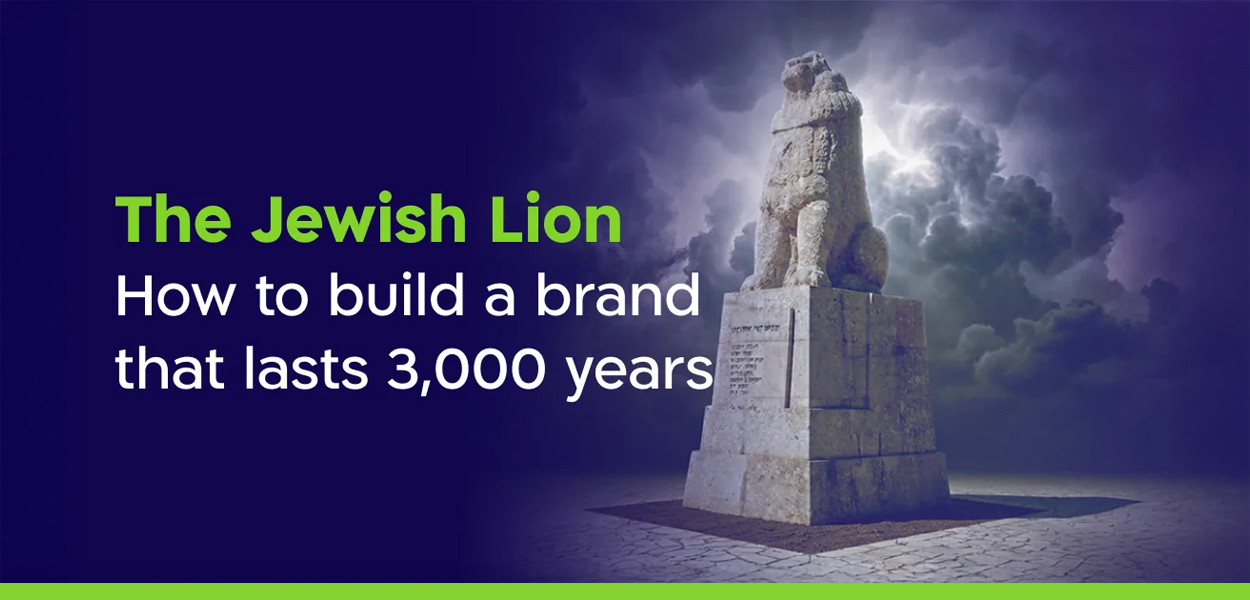
When modern Zionism emerged, it did not invent a new emblem. There was no dramatic visual overhaul. The lion simply shifted tone. Less mystical - more national. Less decorative - more upright. Less memory - more action. This was not a rebrand. It was a tonal update. One of the most powerful visual moments in Israeli cultural history is the “Roaring Lion” monument at Tel Hai. Not a victorious lion. Not a charging lion. A wounded lion - roaring. That is a courageous branding decision. It does not sell “absolute power.” It sells endurance. Resolve. Cost. A brand built on courage through standing firm lasts longer than one built on dominance alone.  

The IDF: A Language of Consciousness, Not Just Operations

When military operations are named “Am KeLavi” or “Roaring Lion,” this is not biblical romanticism. It is narrative strategy. Operation names are never merely technical labels. They are messages. Inward - to soldiers and society. Outward - to adversaries and to the world. The lion enables Israel to position itself as restrained yet determined. Not a wild force. Not an imperial aggressor. But an actor capable of patience - and action. The distinction is subtle. And critical.  

Why It Still Works

Because the lion carries rare historical depth. It bridges scripture and sovereignty. An ancient verse and a modern fighter jet. Memory and statehood. In a world where brands redesign their logos every five years, the Jewish lion is proof that true brand equity is built across generations. Not through trends. Through consistency.  

What Can Branding Professionals Learn From This?

  1. A strong symbol doesn’t need to shout constantly.
  2. Deep brands are anchored in story, not aesthetics alone.
  3. Long-term consistency outperforms cosmetic refreshes.
  4. Restrained power is a strategy - not a weakness.
And perhaps this is the real secret: The lion does not roar all the time. But when it does, it doesn’t sound like a trend. It sounds like history. 🦁
Read More