January 21, 2025

As social media continues to evolve, so do the strategies and trends in digital design. Creators, brands, and marketers constantly look for fresh ways to engage audiences and make an impact. In 2025, several key trends are shaping the digital design landscape, making content more interactive, dynamic, and visually compelling. From video-driven posts to carousel designs and creative use of templates, here’s a look at the top trends in social media design.

The Importance of a Digital Brand Guideline

In the fast-paced world of social media, consistency is crucial for building brand awareness. A digital brand book, or brand guideline document, plays a pivotal role in ensuring that every piece of content across platforms aligns with the brand’s identity.

A well-structured digital brand book for digital defines your brand’s voice, color scheme, typography, imagery style, and logo usage. This not only helps maintain consistency but also strengthens your brand’s presence on social media. Whether you’re creating videos, carousel posts, or stories, having a digital brand book ensures that all design elements are cohesive and instantly recognizable to your audience.

With the rise of user-generated content and templates, a brand book becomes even more essential. As more individuals and tools contribute to your brand’s digital presence, keeping a unified, professional look across all content is key to standing out and building trust with your audience.
Video Takes Center Stage

1. Video Takes Center Stage

Video content is no longer just a trend—it’s the driving force behind social media engagement. Studies show that video posts generate 38% more engagement than image-based posts on platforms like Instagram and Facebook (Hootsuite Social Media Trends Report 2025). Short-form videos, like Instagram Reels, and YouTube Shorts, dominate social feeds. These bite-sized, attention-grabbing clips not only entertain but also inform. Marketers focus on creating high-quality, snappy videos that deliver value quickly, whether through tutorials, behind-the-scenes looks, or product demos.

For designers, this shift means optimizing visuals for mobile viewing, using eye-catching thumbnails, and incorporating motion graphics to enhance storytelling. With video, the goal is to be visually engaging while delivering the message in a way that keeps viewers hooked.

2. Carousel Posts for Storytelling

Carousel posts—where multiple images or videos are swiped through in a single post—have grown in popularity because they allow for rich storytelling and deeper engagement. A well-designed carousel can show step-by-step processes, tell a sequential story, or display a collection of related products.

Carousel posts have grown in popularity, generating 1.4x more reach and 3x more engagement compared to single-image posts (Later Social Media Analysis, 2024).

Designers are getting creative with carousels, blending static images with motion, using contrasting colors, and ensuring each slide is part of a cohesive narrative. The challenge is to keep users interested across all slides, so the visuals need to be both informative and visually stimulating.

3. Template-Driven Design

Templates are becoming a game-changer for creators looking to maintain a consistent aesthetic across platforms. Tools like Canva, Adobe Spark, and others offer customizable templates, making it easier to create on-brand posts quickly. These templates are not just for graphics anymore; they now include layouts for videos, stories, and reels. These templates improve design efficiency by up to 60% (Adobe’s Future of Creativity Report 2024), allowing designers to focus on creativity while reducing production time.

The rise of templates has led to a democratization of design. Whether you’re a small business or a content creator, you can produce polished, professional designs with minimal effort. Templates allow you to focus on customization, ensuring your content stands out while saving time on design work.Interactive and Immersive Content
4. Interactive and Immersive Content

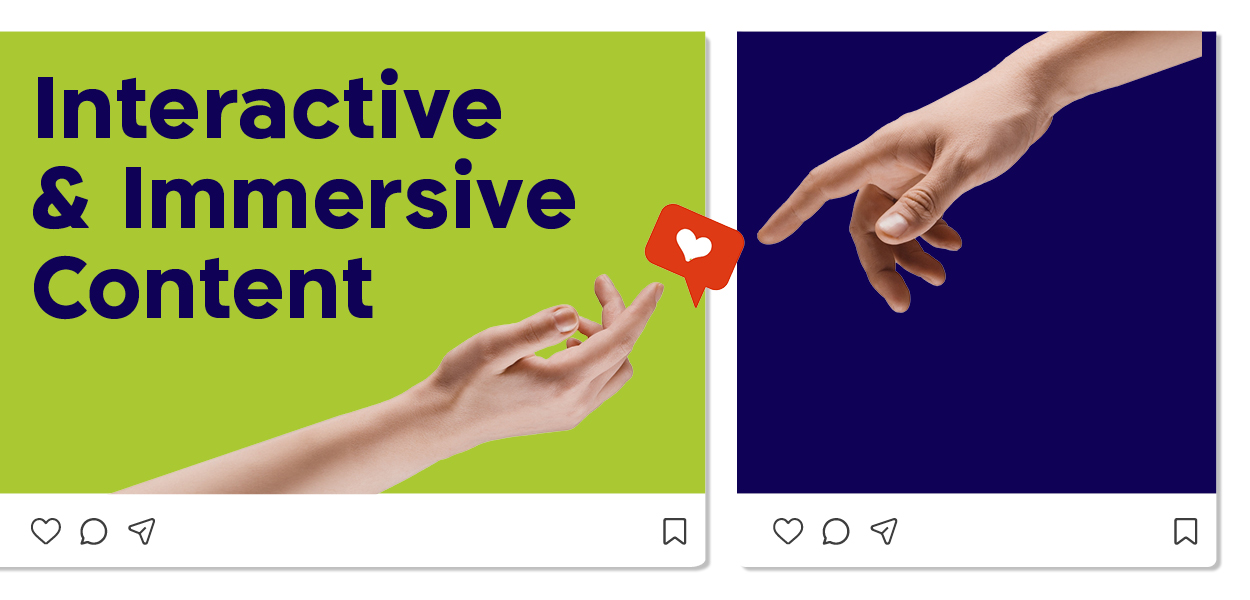
Interactive design elements, such as polls, quizzes, and sliders, increase audience engagement by 30% compared to static posts (Sprout Social Engagement Study, 2024). Instagram Stories with interactive stickers (like polls or questions) receive 15-20% higher completion rates (Instagram Insights 2024).

As social media platforms continue to incorporate advanced features, interactive design is becoming more important. Polls, quizzes, sliders, and other interactive elements are a great way to keep your audience engaged and involved. On Instagram, for example, Stories with interactive stickers (like questions or reactions) provide instant feedback and encourage participation.

Additionally, with the rise of augmented reality (AR) filters and virtual experiences, brands are exploring more immersive ways to engage users. Designers are now creating AR filters, 3D objects, and interactive designs that allow users to engage in a more hands-on way, elevating the traditional post into an experience.

Minimalist Aesthetics with Bold Typography

5. Minimalist Aesthetics with Bold Typography

In a world where attention spans are shrinking, simplicity is key. Minimalist design continues to thrive in social media content, focusing on clean lines, white space, and strong focal points. Bold typography plays a crucial role here, making statements and headlines pop while maintaining an uncluttered look.

Big, readable fonts help convey the message quickly, whether for a meme, announcement, or call-to-action. Minimalist aesthetics combined with striking typography create a powerful visual impact that stands out in crowded feeds.

Minimalist design continues to thrive in social media content, focusing on clean lines, white space, and strong focal points. Posts featuring bold typography and minimalist layouts see 24% higher engagement rates (HubSpot Social Media Trends Report 2024) due to their ability to capture attention quickly in crowded feeds.

6. User-Generated Content (UGC) Integration

Designers are increasingly working with UGC in creative ways to showcase real-life interactions with products or services. Curated customer testimonials, review snapshots, or creative reposts add authenticity to brand messaging. Social media users are more likely to trust peer-generated content, making it a valuable asset for brands looking to build trust.

By integrating UGC into their designs, brands can foster a sense of community, turning users into active participants in the brand’s visual story. The trend also highlights the importance of authenticity and transparency in modern digital marketing.
AI in Creative Design, 3D, and Illustration

7. AI in Creative Design, 3D, and Illustration

Artificial Intelligence (AI) is revolutionizing the way designers approach creative projects. AI tools are now being used to generate new design elements, streamline workflows, and enhance creative processes. From automated image editing to AI-generated illustrations and even personalized content creation, AI is making it easier for designers to produce high-quality visuals in less time.

In addition, AI-powered platforms are enabling the integration of 3D models and illustrations into social media content. This allows brands to create more dynamic and visually striking posts that stand out from traditional 2D designs. Whether it’s for product mockups, animated 3D assets, or hyper-realistic digital art, AI is helping bring complex, interactive visuals to life, giving social media content a fresh, futuristic feel.

With AI, creativity is not just about working smarter; it’s about exploring new possibilities and pushing the boundaries of what’s possible in digital design.

Conclusion

In 2025, digital design on social media is all about creating content that is dynamic, interactive, and visually engaging. From the explosion of video content to the use of carousel posts and templates, designers have more tools than ever to craft impactful visuals that resonate with audiences. Additionally, having a digital brand book ensures that your content remains consistent and strengthens brand awareness across platforms.

By embracing these trends, including the use of AI in creative work, brands, and creators can ensure that their social media presence remains relevant and stands out in an increasingly crowded digital world.
 

Topics:

Interested in more?

Oz Blog B2B Website en

Don’t Be Afraid of the Monster: B2B Websites Aren’t Actually That Scary

By 
Naomi Lifshitz
, 01/12/2025

When B2B sites become complex, smart design brings order and clarity — guiding users, strengthening trust, and helping them move forward with confidence.

min read
A few weeks ago, in a meeting where I presented new website pages to a client, she told me something that stuck with me:
“Honestly? Above everything else, it just looks like you’re really enjoying working on this.”
And she was right. I really am.
Because websites are one of the things I love most in the world.

Why do B2B websites always seem a bit more intimidating?

When people hear “B2B website,” they immediately imagine something heavy: catalogs, products, integrations, CRM systems, and a content tree with thirty pages. And it’s true - this isn’t the website of a jewelry shop or a restaurant. But that’s exactly what makes it interesting. When handled correctly, this complexity turns into clarity.

So how do you actually make it simple?

A website is not a filing cabinet that needs to store every piece of information accumulated over the years. It needs to be focused and relevant. In almost every B2B website I work on, the same pattern repeats itself — templates that help organize the information clearly. And once every piece of content knows where it belongs, everything starts to fall into place. There’s the product - sometimes physical, sometimes digital, sometimes an entire range that needs to be sorted into a clear catalog. Sometimes products are scattered across applications, technologies, or different solutions. In those cases, it’s better to centralize everything under one catalog with smart filtering. This preserves a clear hierarchy and creates a smooth, intuitive user experience. Behind the product lies the technology, which often interests professional audiences and differentiates the company from competitors. On this page, we presented technical and seemingly “dry” information — but in an airy, clean, and clear way. We added a scrolling visual element inspired by the client’s industry, which made the page feel less mechanical and more pleasant and flowing. Then there are the industries or segments where the product operates — because in B2B, there is no “everyone,” only context. There’s also the company’s reputation, the services it provides, and the people behind the scenes. On the Agmatix website, we organized the entire Case Studies archive in a simple, comfortable way. “About” and “Management” pages are almost always among the most visited. Because even in B2B, people look for people. They want to see faces, understand who stands behind the company, and sometimes even recognize someone they know. Look at this innovative About page we created for trendlineslab, It’s innovative because it’s not just “About” - it tells a story. A brand is a story, and that’s exactly what users feel here: a short, clear journey that presents the company through a narrative rather than dry text. And then there’s one of the most important parts — knowledge hubs B2B customers aren’t looking for slogans; they’re looking for information. Articles, guides, real-world examples, case studies. Knowledge that builds trust.

Staying focused throughout the process

One of the biggest challenges in B2B website projects isn’t necessarily design or technology - it’s the people. Every company has several departments with different viewpoints: marketing, sales, product, support, leadership. Everyone has something to say - and rightly so. But if each person sees the website as theirs, the project quickly spreads in all directions. The solution is to work with a small decision-making team: three to four key personas representing the core needs. They don’t need to agree on everything - but they do need to speak the same language and hold the same goal. Once you have that core, every decision becomes easier.  

And what about all the content?

Almost every company has a sea of materials - presentations, brochures, PDFs, guides, old documents. Instead of trying to “fit everything in,” it’s better to start with the opposite question: What does the user actually need to know here? Not everything needs to become a page. Topics like customer stories, updates, or technological innovations are often better as blog posts or part of the Resources section. Blogs are an excellent way to add knowledge and context without overwhelming the site. You can write about almost anything, and the volume can be endless. You can always enrich the content hub, and with smart filtering, still maintain order and clarity.

Functionality comes first

Not long ago I finished designing an especially complex website - catalog-based, with many digital tools and templates. What made it truly successful was its functionality: clear, intuitive, and easy to use. Visitors know exactly where to find what they’re looking for - and to me, that’s the biggest achievement. B2B websites are, first and foremost, work tools. They need to be functional, comfortable, and clear for users. That doesn’t mean giving up on design - the opposite. A modern look that conveys innovation is part of the message: if the website feels up-to-date, the user will feel the company behind it is moving forward. Like on the Aquestia website, where we highlighted the certifications clearly.

It’s all a matter of mindset

If you approach a B2B website with fear - it really will feel like a monster. But if you approach it as a process of organization, structure, and listening - everything becomes clear. A good website doesn’t need to be big, it just needs to work. And to me, that’s the heart of it: turning complexity into clarity - step by step, methodically, and with a small smile along the way.
Read More

Design as an Anchor in a World of Constant Disruption

By 
Amit Sakal
, 19/11/2025

When the market shifts fast, design becomes your anchor—creating clarity, stability, and trust at every touchpoint.

min read
The world around us doesn’t slow down. Markets shift overnight. New competitors appear out of nowhere. Technologies, especially AI - rewrite the rules faster than we can learn them. For most companies, this constant change is both thrilling and exhausting. One moment you’re ahead, the next you’re trying to catch up. But in all this chaos, there’s one thing that can help your brand feel steady - design. Not “design” as in nice colors or a modern website layout, but design as a language of trust. Because when everything around your audience feels unstable, design is the thing that quietly says: We’re still here. We’re solid. You can rely on us.

Why design matters now more than ever

In the B2B world, design has often been treated as an afterthought, something that comes after strategy, product, or pricing. But that view is outdated. Design today does something deeper. It shapes how people feel about your brand, before they even read a word or see a product demo. When the world outside feels unpredictable, a clear and consistent design system becomes your anchor. It tells your customers: “We know who we are, and we’re not going anywhere.” Consistency across your website, social channels, trade shows, and sales decks helps people navigate complexity without getting lost. It’s like a compass - helping them find their way back to you, no matter how much the landscape shifts

Stability and innovation aren’t opposites

Here’s the misconception: that consistency limits creativity. In reality, good design gives innovation a safe place to land. Take IBM. They’ve reinvented themselves countless times - from hardware to cloud to AI, but their design DNA has stayed recognizable: bold typography, clean grids, and that unmistakable IBM blue. The message? Technology evolves, but our foundation is steady. Or Siemens. They operate in industries that are changing by the minute - energy, healthcare, infrastructure, yet their design system ties everything together. It’s what makes them feel like one brand, no matter where you meet them in the world. And Adobe, a masterclass in transformation. They moved from selling software boxes to building creative ecosystems in the cloud. Now they’re redefining creativity with AI tools - but the red square, the simple geometry, and the minimal style haven’t changed. That visual continuity made it easy for their customers to follow them through every pivot. These brands prove a simple truth: Consistency in design doesn’t stop innovation. It makes innovation trustworthy.

What B2B brands should take from this

Many industrial or tech companies still believe design is “just aesthetics.” They assume customers only care about ROI, performance, or reliability. But customers are human. And humans notice design - even subconsciously. A strong design system sends emotional signals of stability and confidence. It helps people trust your innovation, not fear it. So if you want to build long-term relationships, treat your design system as your North Star:
  • Keep it consistent across every touchpoint.
  • Use it to simplify complexity, not add to it.
  • Let it evolve, but never drift away from your brand’s essence.

The AI twist

Now that AI can generate visuals, videos, and brand assets in seconds, design systems matter more than ever!. Without clear guidelines, AI will create a hundred different versions of “you.” That’s not innovation - that’s confusion. Your design language gives AI the guardrails it needs to stay on-brand. So every ad, presentation, or post still feels unmistakably you - even if it was made by a machine.

Final thought

When the world keeps changing, people look for what feels steady. In business, that steadiness often shows up through design. So ask yourself: When your company launches a new product or pivots strategy - will your customers still recognize you? Because in uncertain times, design isn’t just what people see — it’s what makes them stay.
Read More
OZ Global b2b

Let’s Talk About the Cheetah in the Room

By 
Nirit Elyovich, MBA
, 26/08/2025

Is your marketing sprinting in the right direction? A simple five-step process keeps focus on what drives real business results.

min read
Why a cheetah and not an elephant? Because an elephant doesn’t run anywhere - but a cheetah does. Blink, and the year may sprint past you before you’ve managed to focus your marketing on what truly matters for your business. You’ve finally closed your business strategy. The executive team is aligned and committed to the decisions and ambitious goals that were set. Until now, everything fit neatly into the Excel sheet. From this point forward, it’s up to the leadership team to prove execution. Each executive must ensure their function contributes directly to reaching those goals. You return to the office energized - yet not always clear on what this means in practice. How do you turn strategy into action? How do you transform ambition into results? Marketing owns the revenue side of the business. Which means it must be directly tied to business decisions. In our view, any marketing initiative that doesn’t move the needle on company performance - whether short or long term - is irrelevant. As one frustrated CMO once told me: “Unfortunately, whoever shouts loudest wins my attention.” Too often, urgent matters push aside the truly important ones. There are many reasons behind this frustration, which often prevents CMOs from focusing marketing efforts on the company’s core business anchors - prioritizing initiatives with deep impact on business results long before other requests land on their desks. As a company that leads Israeli B2B companies to success in the global market, we’ve developed a structured five-step process to ensure marketing directly advances the company’s business decisions.
  1. Translate business decisions into marketing initiatives Take a disciplined look at your strategy through a marketing lens and identify which decisions can be transformed into marketing moves. Not every business decision needs to land on the marketing desk - that’s exactly why you have multiple executives around the table. The CEO ensures nothing falls through the cracks.
  2. Prioritize five key initiatives Establish clear criteria and select the marketing initiatives with the greatest potential to impact business performance. Keep the list realistic and aligned with budget and leadership attention.
  3. Deep-dive into the chosen initiatives Define success metrics, risks, internal stakeholders, milestones, and timelines for each initiative. This thorough review will also help you reassess whether the initiative you’ve chosen truly has a meaningful impact on business results.
  4. Win executive approval Confirm these are the most meaningful initiatives and gain budget approval. This stage is also an opportunity to sync with fellow executives.
  5. Build the annual marketing plan Break each initiative down into specific actions, map them across the year, and create a logical, effective flow of execution.
From here, it’s all about consistent management - making sure the team works according to plan, monitors results, and improves along the way. The beauty of this process lies in its clarity. Every marketing effort is measured by its direct contribution to the business. If it’s not in the plan, there’s a reason. It may sound simple - and it is - but it requires you to pause, plan, and sometimes partner with an external professional. Someone who will hold you accountable, challenge your thinking, and keep you focused. Someone who’s done this many times before and knows how to steer the process. The cheetah doesn’t wait - and the year won’t either. Now is the time to focus your marketing on what truly matters for your business and drive real impact. We’re here to help.
Read More