March 2, 2026

And no, it doesn’t start with design. It starts with choosing the right ingredients.

When people talk about B2B presentations, the conversation almost always goes to the same place:
Beautiful slides, precise fonts, colors that work well together.

But building a great presentation is a lot like cooking a meal.
It doesn’t start with a beautiful plate, and it doesn’t start with garnish.
It starts with one simple question: who are you cooking for?

Who is sitting at your table?
What do they like to eat?
And what will make them want to come back to your restaurant?

You can invest in expensive ingredients, shiny tools, and perfect plating, but if the dish doesn’t match the diner’s taste, it simply won’t be eaten.

That’s exactly how B2B presentations work.

For a presentation to drive decisions, build trust, and create real business results, it must be tailored to its audience, to the story they are looking to hear, and to an experience that leaves a good taste even after the meeting is over.

That’s where presentations that truly work begin.
A presentation is a strategic business asset.


Strategy first. Design second.

One of the most common mistakes I see is jumping straight into design.
Colors, icons, layouts, before anyone stops to ask the questions that actually affect outcomes:

  • Who is the audience?
  • What action do we want to happen at the end of this presentation?
  • What is the one message every slide must deliver?

Clarity matters more than complexity. Always.

Only when the strategy is clear does design come in and turn something pretty into something effective.

I once worked with a client in the Industrial IoT space who came in with a presentation overloaded with technical details.
I didn’t touch the product. I changed the story:

Problem > Operational impact > Solution > ROI

Suddenly the conversation in the room shifted, and we saw a clear increase in conversion rates already in the first meetings.

A personal tip from experience:
Before designing even a single slide, I always ask to write the customer story in simple language. It guides every content and design decision that follows.


Simplicity wins. Story connects.

Especially in complex B2B environments, simplicity is a real competitive advantage.

  • One slide = one idea
  • Less content = more clarity
  • A strong story = decisions happen

The narrative I return to again and again is:

Challenge > Why it matters > Solution > Proof > Customer value

When I worked with a medical equipment manufacturer that wanted to attract new partners, we reduced everything to one clear message:
“We reduce clinical risk, simply.”

That message changed the dynamic in the room, and the number of follow up meetings doubled.

A practical tip:
Any content that doesn’t directly support the core message doesn’t belong there. If it doesn’t clarify or convince, it distracts.


Presentations that generate real business results

A good presentation doesn’t just look good. It works for the business.

  • Drives sales by translating complexity into clear value
  • Attracts investors by building credibility and highlighting potential
  • Accelerates onboarding by helping teams quickly understand what matters
  • Strengthens the brand by projecting professionalism and consistency

An energy startup I worked with came in with an inconsistent, text heavy presentation. After refining their brand story and redesigning the deck, they raised funding in the following quarter.

An honest tip:
I always ask myself whether this presentation would convince me if I were sitting on the other side of the table. If the answer is no, we keep refining.


A presentation is a business tool, not a graphic file

A presentation keeps working even when you’re not in the room.

  • It gets passed along to decision makers you never meet
  • It creates an internal narrative inside the organization
  • It reinforces the brand over time

When done right, a presentation creates that “aha” moment far beyond any animation or color palette.

What works for me:
I treat presentations as marketing tools that operate 24/7. Every slide needs to stand on its own.


Turning presentations into a growth engine

A presentation becomes a strategic asset when it:

  • Connects the audience to the solution, not just the company
  • Communicates value clearly, even in complex industries
  • Supports the customer throughout the decision journey
  • Maintains brand consistency at every touchpoint

Simply put:
Slides don’t just tell your story.
They drive business results.


So before serving the dish, a quick recap:

  • Start with strategy, not visuals
  • Simplicity and a strong story beat overload
  • Measure presentations by outcomes, not aesthetics
  • It’s a business tool, not a design file

Listen to the podcast of this post

Want to create a presentation that drives results

Contact Us

Topics:

Interested in more?

Facebook EN 1

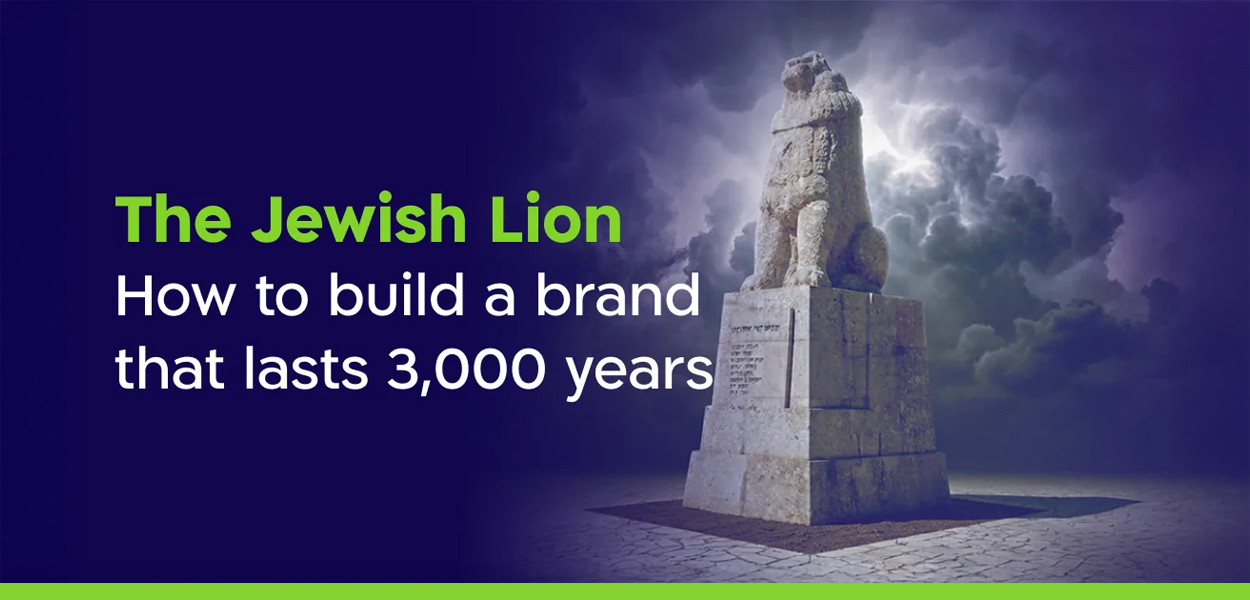
The Jewish Lion: How to Build a Brand That Lasts 3,000 Years

By 
Amit Sakal
, 04/03/2026

Beyond ancient symbols: How do you build a brand that lasts for millennia? Discover the fascinating branding strategy behind the Jewish Lion – from the Bible to the modern battlefield.

min read

How do you build a brand that lasts for millennia? If you are wondering how to build a brand that lasts for generations, the answer lies in one ancient symbol.Lately, certain names have resurfaced: “Am KeLavi” - A People Like a Lion. “Roaring Lion.”

Operation names. Security language. Headlines. But from a branding perspective, this is a fascinating choice. In an era when nations invest billions in narrative, public diplomacy, and perception management, Israel repeatedly returns to the same ancient symbol: the lion. Not a refreshed logo. Not an updated digital aesthetic. Not a passing graphic trend. A lion. And when you examine it closely, it may be one of the most consistent branding moves in human history.  

A Brand That Hasn’t Rebranded Since Genesis

The story begins long before content strategy or visual systems. In the Book of Genesis, Jacob blesses Judah with the words: “Gur Aryeh Yehuda” - Judah is a lion’s cub. This wasn’t merely poetic imagery. It was a foundational positioning decision. The lion wasn’t chosen because it is the strongest animal in the wild. It was chosen because it is perceived as sovereign - a natural authority, a presence that does not need to strive for dominance. In branding terms, this is precise positioning. The lion does not symbolize reckless aggression. It represents restrained power. Not “we attack.” But “we are here - and we are not going anywhere.” That is a far deeper message than brute force.  

Design in Exile: When There Is No State, There Is Still a Visual Language

For nearly two thousand years, there was no sovereignty. But there was branding. The lion appeared in synagogues, on Torah arks, in manuscripts - often flanking the Tablets of the Covenant, sometimes crowned. From a design perspective, this was brilliant: When political power disappears, you reinforce the symbol. During exile, the lion was not a call to rebellion. It was an anchor of identity. A form of brand consistency in the midst of historical chaos. Real brands are not built in comfortable eras. They are tested in difficult ones.  

Zionism: Rebranding Without Losing the DNA

When modern Zionism emerged, it did not invent a new emblem. There was no dramatic visual overhaul. The lion simply shifted tone. Less mystical - more national. Less decorative - more upright. Less memory - more action. This was not a rebrand. It was a tonal update. One of the most powerful visual moments in Israeli cultural history is the “Roaring Lion” monument at Tel Hai. Not a victorious lion. Not a charging lion. A wounded lion - roaring. That is a courageous branding decision. It does not sell “absolute power.” It sells endurance. Resolve. Cost. A brand built on courage through standing firm lasts longer than one built on dominance alone.  

The IDF: A Language of Consciousness, Not Just Operations

When military operations are named “Am KeLavi” or “Roaring Lion,” this is not biblical romanticism. It is narrative strategy. Operation names are never merely technical labels. They are messages. Inward - to soldiers and society. Outward - to adversaries and to the world. The lion enables Israel to position itself as restrained yet determined. Not a wild force. Not an imperial aggressor. But an actor capable of patience - and action. The distinction is subtle. And critical.  

Why It Still Works

Because the lion carries rare historical depth. It bridges scripture and sovereignty. An ancient verse and a modern fighter jet. Memory and statehood. In a world where brands redesign their logos every five years, the Jewish lion is proof that true brand equity is built across generations. Not through trends. Through consistency.  

What Can Branding Professionals Learn From This?

  1. A strong symbol doesn’t need to shout constantly.
  2. Deep brands are anchored in story, not aesthetics alone.
  3. Long-term consistency outperforms cosmetic refreshes.
  4. Restrained power is a strategy - not a weakness.
And perhaps this is the real secret: The lion does not roar all the time. But when it does, it doesn’t sound like a trend. It sounds like history. 🦁
Read More
Facebook EN 1

Marketing in China: Not Just Another Market- A World of Its Own!

By 
Sivan Barkay Menachem
, 10/02/2026

China isn’t just another market—it’s a parallel universe with its own rules for AI, social media, and visual language that every global brand must learn.

min read
As Chinese New Year approaches, we decided to pause and take a closer look at marketing in China. Not because we are experts in this field, we are not, and we don’t pretend to be. Quite the opposite. Precisely because China is such a unique, complex, and highly specialized market, we felt it was worth sharing a short overview to help Israeli companies understand why China is fundamentally different from any other market they may know. China is not Europe. It is not the U.S. And it is certainly not an extension of an existing global strategy.

Color, Visual Language, and Regulation: More Than Aesthetic Choices

In China, color is not a matter of taste, it is a language. Colors carry deep cultural, symbolic, and sometimes political meaning, and incorrect use can confuse audiences, weaken trust, or even lead to content being restricted. For example:
  • Red is associated with luck, success, and celebration. It is widely used, but poor balance can feel loud or low-end.
  • White is strongly linked to mourning and loss, making it problematic as a dominant color in celebratory or brand-driven contexts.
  • Black conveys formality and authority, but in certain contexts can feel distant or somber.
  • Certain color combinations, symbols, icons, or visual metaphors may be culturally or politically sensitive, even if they are considered neutral in Western markets.
Beyond design, China enforces strict regulations on messaging and imagery. Claims, comparisons, representations of authority, health, security, and even tone of voice are closely monitored. Content that is perfectly acceptable in Israel, Europe, or the U.S. may never make it live in China.  

Social Media: Same Goals, Completely Different Ecosystem

China does not use Facebook, Instagram, LinkedIn, or X. Instead, it operates within its own ecosystem of platforms such as WeChat, Weibo, Rednote, Douyin, and others, each of which functions far beyond what Western audiences think of as “social media.” WeChat, for example, combines content, community, CRM, customer service, payments, and commerce in one tightly integrated environment. As a result, effective marketing in China, particularly on WeChat, goes beyond reach or engagement and focuses on building long-term relationships within a closed, all-in-one platform.  

Search Engines: Google Is Not Part of the Equation

Google is largely irrelevant in China. Search behavior is driven primarily by Baidu and other local engines, each with different algorithms, SEO rules, and content expectations. Simply translating a website or blog into Chinese is not enough. Effective visibility requires content structure, hierarchy, and language that align with how Chinese users search for and evaluate information.  

Chinese AI: A Parallel Universe, not a Local Version

Artificial intelligence in China also operates in a parallel ecosystem. Many Western AI tools are restricted or unavailable, replaced by local models such as ERNIE, Qwen, Doubao, and others. The differences are not only technical, but conceptual:
  • These models are trained on different datasets, in different cultural and regulatory contexts.
  • Clear limitations exist on topics, phrasing, and types of content.
  • AI is often embedded directly into Chinese platforms rather than offered as open, standalone tools – especially in Baidu’s case.
From a marketing perspective, this impacts content creation, research, automation, and even how brands communicate with customers. Relying solely on Western AI tools quickly becomes irrelevant in the Chinese market.  

Local Partnerships as a Strategic Advantage

Marketing in China is extremely difficult to manage remotely. Language, regulation, culture, platform behavior, and business norms require deep, on-the-ground understanding. This is where local expertise becomes essential. We have worked for many years with Brandigo, and have seen firsthand their deep expertise in B2B marketing within the Chinese market- from strategic positioning and message localization to smart use of local platforms and cultural nuance. Strong local partners bridge the gap between Western brands and Chinese audiences without sacrificing credibility.

The Bottom Line

China is not “just another large market.” It is a self-contained system with its own rules, pace, and internal logic. Succeeding there requires humility, learning, true localization, and the right partners. We are not experts in Chinese marketing, but we know when expertise is required. And in a market like China, that distinction makes all the difference.

Want to dive deeper into B2B marketing in China?

We highly recommend exploring the Brandigo blog, where they share in-depth insights, practical experience, and up-to-date perspectives on navigating the Chinese B2B market- https://www.brandigochina.com/blog  
Read More
Blog Banner eng

B2B Design & Tech Trends 2026: From Visual Appeal to Strategic Experience

By 
Amit Sakal
, 12/01/2026

In 2026, B2B design is more than just a modern look—it’s a strategic engine for clarity. Discover the six key shifts, from Hybrid Intelligence to Vibe Code, that help users understand complex products and drive faster decisions.

min read
Design and tech trends in 2026 reveal that B2B design isn’t just about looking modern. It’s about clarity. It’s about helping users understand complex products faster, feel more confident, and make decisions with less friction. As buying journeys become more self-directed, design is evolving into a strategic layer that connects technology, experience, and business outcomes. Here are the six shifts defining this evolution.  

Multi-Sensory Experiences & Hybrid Intelligence When design is felt, not just seen

2026 marks a clear shift from purely visual design to multi-sensory digital experiences. After years of screen fatigue, users crave interfaces that feel richer, more immersive, and more human. Even in digital environments, design now aims to evoke sensations associated with touch, depth, motion, and materiality. This is where Hybrid Intelligence: the collaboration between AI and human creativity becomes a powerful driver. AI is deeply embedded into the creative workflow:
  • Generating visual directions and variations
  • Exploring textures, motion, and spatial depth
  • Accelerating experimentation and ideation
But AI does not define the experience on its own. Human designers provide intention, judgment, emotion, and narrative. The result is a new visual language:
  • Soft, tactile, and inflated textures
  • Hyper-realistic objects combined with playful distortions
  • Subtle motion that suggests weight, resistance, and flow
  • Interfaces that feel immersive rather than flat
For B2B brands, this matters because complex products are easier to understand when users feel immersed rather than overwhelmed. Multi-sensory design creates memorability, emotional connection, and clarity - even in highly technical environments. 2026 is not about “man versus machine.” It’s about a creative dialogue where AI enhances precision and scale, while humans shape meaning and direction.  

Glassmorphism, Evolved Transparency as a system, not a decoration

Glassmorphism continues into 2026 - but in a more mature and intentional form. What once appeared as a visual trend is now becoming a functional design system used to manage hierarchy, density, and focus. In B2B interfaces especially, where dashboards, data layers, and dense content are common, glass-like surfaces help:
  • Separate layers without heavy borders
  • Maintain context while guiding attention
  • Create depth without visual noise
Frosted transparency, subtle blur, and soft edges are used to organize complexity rather than decorate it. The key shift in 2026: Glassmorphism is no longer an effect - it’s a structural tool that supports clarity, readability, and navigation in sophisticated digital products.  

Vibe Code & Self-Serve UX Design that explains before sales ever enter the room

Modern B2B buyers don’t want to be sold to first - they want to understand. In 2026, the most effective B2B experiences are built around self-serve exploration:
  • Interactive demos
  • Calculators and simulators
  • Product explorers and configurators
  • Guided journeys that adapt to user intent
This approach is often referred to as Vibe Code, a design mindset where the interface communicates the product’s value intuitively, without requiring explanations. Good self-serve design reduces friction by:
  • Answering questions before they are asked
  • Allowing users to test scenarios on their own
  • Building confidence before human interaction
For B2B companies, this shortens sales cycles and improves lead quality. For users, it creates a sense of control and trust. In 2026, design is no longer a wrapper around the product - it becomes the product’s first conversation with the user.  

White, Minimalism & Visual Calm Less noise, more authority

White and near-white palettes dominate B2B design in 2026, not as an aesthetic trend, but as a strategic choice. Minimalist layouts, generous spacing, and visual restraint are essential when:
  • Products are complex
  • Messages need credibility
  • Decisions carry high business impact
White space creates hierarchy, improves readability, and allows content to breathe. It also signals confidence: brands that don’t need to shout are often perceived as more trustworthy. In a world saturated with color, motion, and stimulation, visual calm becomes a differentiator. For B2B brands, minimalism is not about being “empty” it’s about being precise, focused, and intentional.  

Dynamic Personalization at Scale One interface, many audiences

B2B audiences are rarely uniform. Different roles, industries, regions, and levels of expertise require different messaging and in 2026, design finally reflects that reality. Interfaces are becoming more adaptive:
  • Content shifts based on industry or role
  • Messaging adjusts to user behavior or entry point
  • Visual emphasis changes according to intent
This doesn’t mean building dozens of websites, it means designing modular systems that can respond dynamically. Personalization in 2026 is subtle, intelligent, and contextual. When done right, users feel that the product “speaks their language” without being intrusive or obvious.  

Design as a System, Not a Page Modular, scalable, and built for growth

In 2026, strong B2B design is rarely page-based. It’s system-based. Design systems evolve to support:
  • Rapid scaling across products and markets
  • Consistency across platforms and touchpoints
  • Faster iteration without breaking brand integrity
Components are flexible, reusable, and designed with future expansion in mind. This shift reflects a broader understanding: Design is no longer a one-time deliverable it’s an operational asset. For B2B organizations, system-driven design enables speed, clarity, and long-term efficiency — without sacrificing creativity.  

Closing Thought

Design in 2026 is not about trends for the sake of trends. It’s about using design to reduce complexity, build trust, and create meaningful experiences in an increasingly technical world. For B2B brands, the opportunity is clear: Those who treat design as a strategic layer - not a visual afterthought — will lead the conversation, not follow it.
Read More