March 4, 2026
How do you build a brand that lasts for millennia?
If you are wondering how to build a brand that lasts for generations, the answer lies in one ancient symbol.Lately, certain names have resurfaced:
“Am KeLavi” – A People Like a Lion.
“Roaring Lion.”
Operation names. Security language. Headlines.
But from a branding perspective, this is a fascinating choice.
In an era when nations invest billions in narrative, public diplomacy, and perception management, Israel repeatedly returns to the same ancient symbol: the lion.
Not a refreshed logo.
Not an updated digital aesthetic.
Not a passing graphic trend.
A lion.
And when you examine it closely, it may be one of the most consistent branding moves in human history.

A Brand That Hasn’t Rebranded Since Genesis
The story begins long before content strategy or visual systems.
In the Book of Genesis, Jacob blesses Judah with the words: “Gur Aryeh Yehuda” – Judah is a lion’s cub.
This wasn’t merely poetic imagery. It was a foundational positioning decision.
The lion wasn’t chosen because it is the strongest animal in the wild. It was chosen because it is perceived as sovereign – a natural authority, a presence that does not need to strive for dominance.
In branding terms, this is precise positioning.
The lion does not symbolize reckless aggression.
It represents restrained power.
Not “we attack.”
But “we are here – and we are not going anywhere.”
That is a far deeper message than brute force.

Design in Exile: When There Is No State, There Is Still a Visual Language
For nearly two thousand years, there was no sovereignty.
But there was branding.
The lion appeared in synagogues, on Torah arks, in manuscripts – often flanking the Tablets of the Covenant, sometimes crowned.
From a design perspective, this was brilliant:
When political power disappears, you reinforce the symbol.
During exile, the lion was not a call to rebellion.
It was an anchor of identity.
A form of brand consistency in the midst of historical chaos.
Real brands are not built in comfortable eras.
They are tested in difficult ones.

Zionism: Rebranding Without Losing the DNA
When modern Zionism emerged, it did not invent a new emblem.
There was no dramatic visual overhaul.
The lion simply shifted tone.
Less mystical – more national.
Less decorative – more upright.
Less memory – more action.
This was not a rebrand.
It was a tonal update.
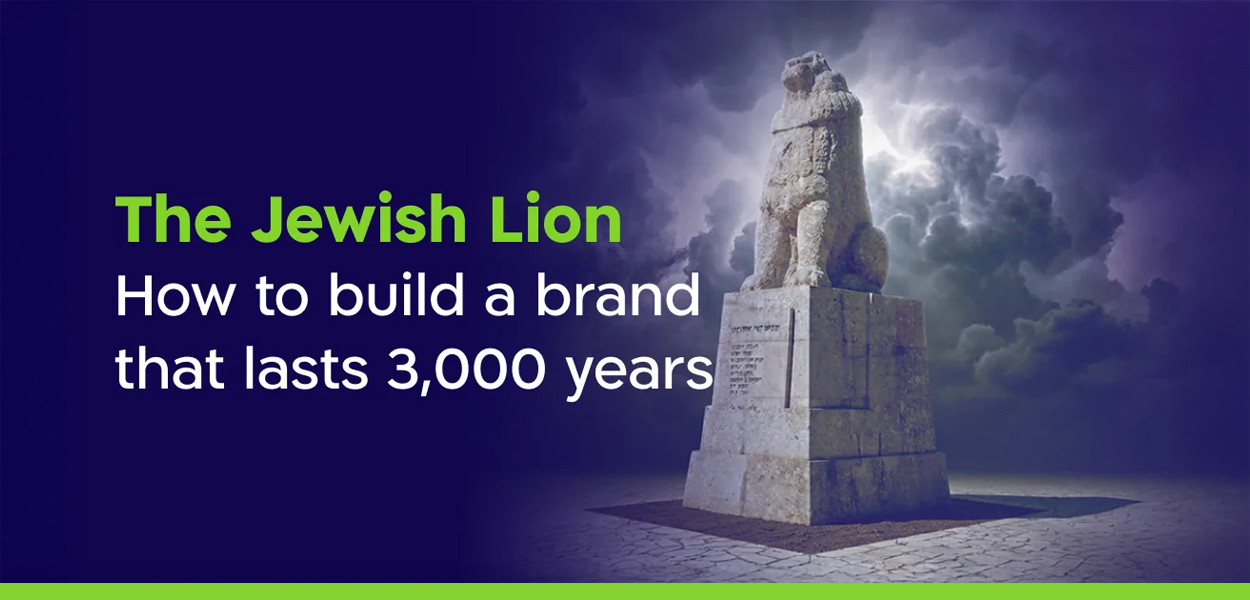
One of the most powerful visual moments in Israeli cultural history is the “Roaring Lion” monument at Tel Hai.
Not a victorious lion.
Not a charging lion.
A wounded lion – roaring.
That is a courageous branding decision.
It does not sell “absolute power.”
It sells endurance. Resolve. Cost.
A brand built on courage through standing firm lasts longer than one built on dominance alone.

The IDF: A Language of Consciousness, Not Just Operations
When military operations are named “Am KeLavi” or “Roaring Lion,” this is not biblical romanticism. It is narrative strategy.
Operation names are never merely technical labels. They are messages.
Inward – to soldiers and society.
Outward – to adversaries and to the world.
The lion enables Israel to position itself as restrained yet determined.
Not a wild force.
Not an imperial aggressor.
But an actor capable of patience – and action.
The distinction is subtle.
And critical.

Why It Still Works
Because the lion carries rare historical depth.
It bridges scripture and sovereignty.
An ancient verse and a modern fighter jet.
Memory and statehood.
In a world where brands redesign their logos every five years, the Jewish lion is proof that true brand equity is built across generations.
Not through trends.
Through consistency.

What Can Branding Professionals Learn From This?
- A strong symbol doesn’t need to shout constantly.
- Deep brands are anchored in story, not aesthetics alone.
- Long-term consistency outperforms cosmetic refreshes.
- Restrained power is a strategy – not a weakness.
And perhaps this is the real secret:
The lion does not roar all the time.
But when it does,
it doesn’t sound like a trend.
It sounds like history. 🦁